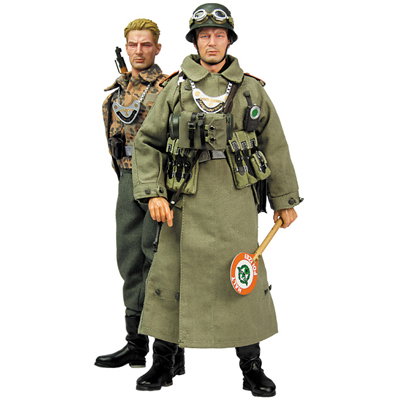
Description
Did Jakob Blau Feldgendarme
The roots of military police in the German armed forces can be traced back to
the "Proffoss"of the 16th Century, and the creation of the Reitendes
Feldjagerkorps by Friedrich II in 1740. The primary duties of the Reitendes
Feldjagerkorps were to control traffic, to carry important messages, and to
protect members of the royal family. Springing from this band was the
Feldjagerkorps zu Fuss (1741) which served both in the Napoleonic Wars and the
Franco-Prussian War.
The start of WWII opened the floodgates for numerous police formations to form
and characterized the sometimes-chaotic hierarchy of the German armed forces.
Civilian police units would form the basis for the Fallschirmtruppen as well as
a number of Waffen SS divisions too with at least two well known commanders Sepp
Dietrich and Kurt Meyer of the 12th SS serving as policemen prior to joining the
military.
The organization of the Feldgendarmerie began at the German High Command O.K.H
(Oberkommando Des Heeres). Within the German Army of the Third Reich, the
"Feldgendarmerie" (also known as "Kettenhunde" or "Chain Dogs") was a military
organization that had received full infantry training and yet had extensive
police powers. These military police units were employed with army divisions and
higher formations. "Feldgendarmerie" establishments provided various different
detachments which were self-contained units under the command of an army
division. They worked in close cooperation with the Secret Field Police
("Geheime Feldpolizei") and with district commanders and town majors.
In Potsdam there was a military police school set up for the purpose of training
military police and the subjects taught in these schools were as follows:
Criminal code, general and special police powers, forestry, fishery and waterway
codes, traffic codes, industrial codes, reporting duties, passport and
identification duties, folk culture, first aid, weapons drill and instruction,
shooting, defense techniques, criminal police methodology, identification
service and general correspondence training. As well as all
this there were also lessons in air defense, animal protection and typewriter
and stenography courses.
At the war's end many Feldgendarmerie, specifically those who had not fallen
into Soviet hands, found themselves assigned to police roles by the Allies. This
happened on a few occasions and an officer of the 101st Airborne Division
recalls assigning Feldgendarmerie to guard German officers who had been ordered
to take charge of German prisoners of war. Another account goes one further and
recalls the British 8th Corps based in Schleswig-Holstein forming an entire
regiment of Feldgendarmerie to maintain discipline and order in the
Demobilisation Centre at Meldorf. Four battalions and a regimental staff
battalion, this Feldgendarmerie-Regiement Krps contained all volunteers, some of
whom were ex-police personnel. They wore an armband as identification which bore
the legend "Wehrmactordnungstruppe" (Armed Forces Order Troop) and below this
read "Military Police". They were all armed and payment for their services came
in the form of increased rations.