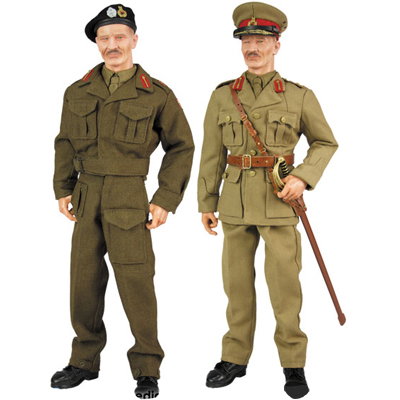
Description
Did - Bernard Law Montgomery
Click here [http://www.machinegun.fr/images/MONTGOMERY-800.jpg] to see inside
box (MachineGun.fr pictures)
Field Marshal Bernard Law Montgomery, often referred to as "Monty", was an
Anglo-Irish British Army officer. He
successfully commanded Allied forces at the Battle of El Alamein, a major
turning point in the Western Desert
Desert Campaign during World War II, and troops under his command played a major
role in the expulsion of Axis
forces from North Africa. He was later a prominent commander in Italy and
North-West Europe, where he was
in command of all Allied ground forces during Operation Overlord until after
the Battle of Normandy.
Montgomery was born in Kennington, London in 1887, the fourth child of nine, to
an Anglo-Irish Anglican priest,
Reverend Henry Montgomery and Maud Montgomery. Montgomery went to St Paul's
School and then the Royal
Military Academy, Sandhurst, from which he was almost expelled for setting fire
to a fellow cadet during a fight
with pokers. He joined the 1st Battalion, The Royal Warwickshire Regiment in
1908, first seeing service in India
until 1913.
The First World War began in August 1914 and Montgomery moved to France with his
regiment that month. He
saw service during the retreat from Mons, during which half the men in his
battalion became casualties or
prisoners. He was awarded the DSO for gallant leadership. Montgomery served at
the battles of the Lys and
Chemin-des-Dames before finishing the war as General Staff Officer 1 and
effectively chief of staff of the 47th
(2nd London) Division, with the temporary rank of lieutenant-colonel.
Britain declared war on Germany on 3 September 1939. The 3rd Division was
deployed to Belgium as part of the
British Expeditionary Force (BEF). Montgomery predicted a disaster similar to
that in 1914, and so spent the Phony
War training his troops for tactical retreat rather than offensive operations.
Montgomery's training paid off when
the Germans began their invasion of the Low Countries on 10 May 1940 and the 3rd
Division advanced to the
River Dijle and then withdrew to Dunkirk with great professionalism, returning
to Britain intact with minimal
casualties. During Operation Dynamo — the evacuation of 330,000 BEF and French
troops to Britain.
In July 1940 he was promoted to lieutenant-general, placed in command of V Corps
and started a long-running
feud with the new commander-in-chief, Southern Command, Claude Auchinleck. In
April 1941 he became
commander of XII Corps and in December 1941 renamed the South-Eastern Command
the South-Eastern Army
to promote offensive spirit. During this time he developed and rehearsed his
ideas and trained his soldiers,
culminating in Exercise Tiger in May 1942, a combined forces exercise involving
100,000 troops.
Montgomery returned to Britain to take command of the 21st Army Group which
consisted of all Allied ground
forces that would take part in Operation Overlord, the invasion of Normandy. As
with his takeover of the Eighth
Army, Montgomery travelled frequently to his units, raising morale and ensuring
training was progressing. At
St Paul's School on 7 April and 15 May he presented his strategy for the
invasion. He envisaged a ninety day
battle, ending when all the forces reached the Seine, pivoting on an Allied-held
Caen, with British and Canadian
armies forming a shoulder and the US armies wheeling on the right.
On 4 May 1945, on Lüneburg Heath, Montgomery accepted the surrender of German
forces in northern Germany,
Denmark and the Netherlands. Characteristically, this was done plainly in a tent
without any ceremony. In the
same year he was awarded the Order of the Elephant, the highest order in
Denmark. On 26 October 1945 he
was made a Freeman of Huddersfield.